

Introduction:
In 2025, India’s real estate growth story is no longer confined to metros like Mumbai, Bengaluru, or Delhi. The real action has moved to Tier-2 and Tier-3 cities — places once considered “affordable alternatives” that are now thriving as self-sufficient economic centers.
Tier-2 cities have seen a 35–40% jump in housing demand over the past two years. Migration trends show young professionals, entrepreneurs, and even corporates shifting base to cities such as Indore, Coimbatore, Lucknow, and Bhubaneswar, thanks to better work-life balance, lower living costs, and expanding infrastructure.
A story that sums it up:
A Bengaluru-based family sold their small 2BHK apartment and moved to Mysuru. The same budget got them a spacious 4BHK villa with a garden — and a 20-minute commute instead of 2 hours.
What Makes a Tier-2/Tier-3 City? Definitions, Examples, and 2025 Rankings
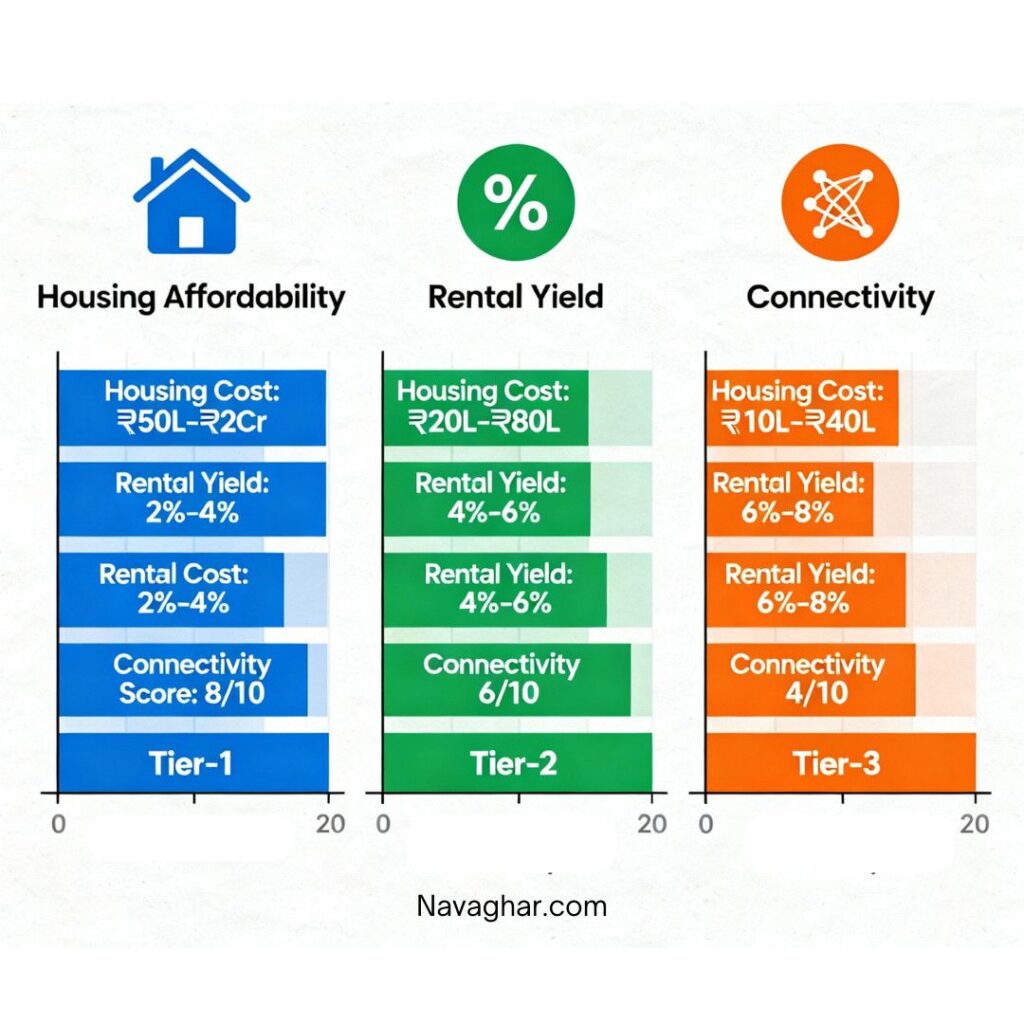
Tier-2 cities typically have a population between 50 lakh and 1 crore, with developing infrastructure, IT parks, and strong industrial bases.
Tier-3 cities are smaller (5–50 lakh people) but are now catching up fast, primarily through smart city missions and real estate reforms.
Top Tier-2 Cities
- Pune
- Lucknow
- Coimbatore
- Indore
- Surat
- Chandigarh
- Jaipur
Emerging Tier-3 Cities
- Nagpur
- Bhubaneswar
- Nashik
- Mangalore
- Dehradun
- Vadodara
Read full blog: Why Tier-2 Cities Are the New Real Estate Hotspots in India
Why Buyers and Investors Are Flocking to These Cities
- Greater ROI: Property rates are 40–60% lower than metros, but rental yields are rising faster — making them investor magnets.
- Infrastructure Boom: Metro rail projects, new airports, and industrial corridors are transforming connectivity.
- Job Creation: Tier-2 cities now host IT parks, manufacturing zones, and logistics hubs. Example: TCS in Indore and Infosys in Nagpur.
- Remote Work Revolution: The work-from-anywhere mindset has made smaller cities a top choice for professionals.
- Government Push: Schemes like AMRUT 2.0, PM Awas Yojana, and Smart Cities Mission are driving sustainable development.
Real Buyer and Investor Stories: Life & Returns Beyond the Metros
1. The NRI Who Bet on Surat — and Won Big
Investor: Amit Patel, 42, Dubai-based NRI
Investment: ₹75 lakh in a 2BHK flat in Surat (2021)
Outcome: Property value grew to ₹1.2 crore by 2025
Amit had been exploring investment options in India, but found metro prices too high. When the Surat Diamond Bourse was announced, he purchased an under-construction flat nearby.
Surat’s growth isn’t hype anymore — it’s visible. Rental demand from diamond industry professionals is constant,” he says.
He now earns a 6% rental yield and is exploring a second property in Bharuch.
2. The Tech Couple Who Left Bangalore for Indore
Investors: Rashi & Ankit Mehta, IT professionals
Investment: 3BHK villa in Indore for ₹90 lakh (2022)
Outcome: 25% value appreciation + better lifestyle
The couple worked remotely during the pandemic and wanted a slower pace of life. They moved to Indore, attracted by new IT parks and clean city rankings.
“We sold our Bengaluru apartment and bought a bigger home with green surroundings and shorter commutes,” Rashi says.
Their property’s value rose as Infosys and TCS expanded offices in the region, making Indore a top-tier job hub.
3. The Retiree Who Found Peace (and Profit) in Dehradun
Investor: Colonel (Retd.) Arvind Sharma, 65
Investment: ₹55 lakh in a retirement home near Mussoorie Road (2020)
Outcome: 40% price appreciation + strong rental demand
After retiring from the Indian Army, Col. Sharma looked for a peaceful city with good medical facilities. Dehradun’s climate and infrastructure made it ideal.
“I didn’t invest for money, but the growth surprised me. Demand from Delhi retirees and working couples is huge.”
His home is now worth around ₹80 lakh, and he rents it seasonally to working professionals relocating from NCR.
4. The Entrepreneur Who Saw Opportunity in Lucknow
Investor: Deepak Agarwal, 36, Small business owner
Investment: Commercial space near Gomti Nagar, ₹1.1 crore (2021)
Outcome: 35% appreciation + 7% annual rental yield
Deepak wanted to expand his business from Kanpur but found Lucknow’s new expressway connectivity more promising.
“The new airport expansion and IT park brought a wave of startups. Demand for small offices doubled,” he shares.
His property value grew steadily as Lucknow emerged as a Tier-2 startup capital of North India.
5. The Millennial Investor in Coimbatore
Investor: Shruti Iyer, 29, Product Designer
Investment: ₹40 lakh in a studio apartment (2022)
Outcome: Airbnb income + 20% appreciation
Shruti bought her first property after working remotely from Coimbatore.
“I wanted something affordable yet future-proof. With the Coimbatore Smart City plan and new airport terminal, short-term rentals are booming.”
Her apartment now earns ₹40,000–₹50,000/month via vacation stays.
Challenges: What to Know Before Investing in Tier-2/Tier-3 Cities
Every opportunity has its challenges. Investors should stay aware of:
| Challenge | Impact | Smart Solution |
|---|---|---|
| Delayed Project Deliveries | Slower returns | Choose RERA-approved builders |
| Limited Liquidity | Harder resale | Focus on rental yield |
| Infra Gaps | May affect value | Invest near upcoming projects |
| Lack of Data | Poor research | Use property analytics tools |
| Regulatory Delays | Longer approvals | Work with local consultants |
FAQs
Indore, Coimbatore, Surat, and Lucknow lead due to balanced growth and affordability.
Yes, but verify legal clearances and the builder’s track record carefully.
Tier-2 cities offer 3–6% average yield, sometimes higher than metros due to rising demand.
Under PMAY-U, buyers can avail credit-linked subsidies. Many states offer stamp duty rebates for women and first-time buyers.
Connectivity, upcoming job centers, and RERA registration are key indicators of future appreciation.
Conclusion:
Absolutely — the shift is structural, not temporary. As metros get saturated and expensive, India’s Tier-2 and Tier-3 cities will define the next decade of real estate growth.