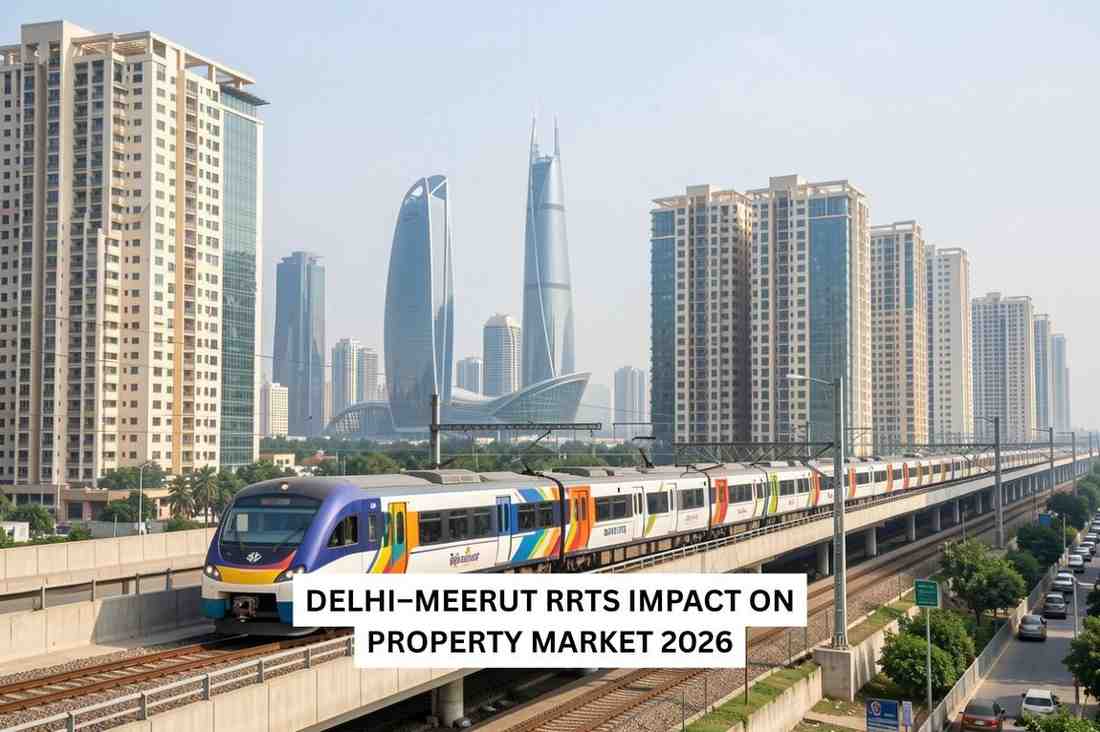
The long-awaited Delhi–Meerut RRTS is now fully operational. It is already changing how people think about living in NCR.
With high-speed Namo Bharat trains cutting travel time to under an hour, Delhi and Meerut feel closer than ever. What was once a long journey is now a daily commute.
This project is no longer just a transport upgrade. It could reshape the region’s property market.
But will better connectivity really increase housing demand — or is the excitement too early?
Here’s what is happening on the ground.
45 Minutes Between Delhi and Meerut Changes Everything
For decades, distance-limited housing decisions have been made in NCR.
Now:
- Delhi to Meerut in ~45–60 minutes
- Faster, predictable daily commute
- Dedicated high-speed regional rail
- Seamless integration with Metro and city networks
For working professionals, this means one big shift:
You can live farther — without feeling far.
And that psychological shift often drives property demand before anything else.
Property Prices Were Already Rising. Now Expect Acceleration.
Even before full operations, micro-markets near RRTS stations saw noticeable appreciation.
Areas witnessing strong traction include:
- Ghaziabad
- Meerut
- Modipuram
- Muradnagar
- Indirapuram
- Pallavpuram
Developers had started acquiring land near stations in anticipation of completion. Now that the entire corridor is active, the speculative phase is shifting into an end-user demand cycle.
The Rise of “Live in Meerut, Work in Delhi”
Affordability is the biggest catalyst.
Compared to central Delhi, Gurugram, or Noida:
- Property prices in Meerut remain significantly lower
- Larger homes are available within the same budget
- Land parcels are more accessible
With RRTS cutting travel time dramatically, Meerut and parts of Ghaziabad are now viable residential alternatives—not just weekend destinations.
This transition from “secondary city” to “commuter city” is where the real estate story gets interesting.
Transit-Oriented Development (TOD) Is the Real Game-Changer
The National Capital Region is slowly adopting Transit-Oriented Development models — dense, mixed-use zones around transit hubs.
What this means:
- Residential + retail + office near stations
- Higher footfall
- Improved rental potential
- Better commercial viability
If TOD is implemented effectively around RRTS stations, station influence zones could outperform surrounding areas over the next 5–8 years.
Commercial Demand: Slower, But Strategic
Residential demand usually reacts more quickly than commercial demand.
However:
- Retail clusters near stations will likely grow
- Co-working and flex offices may expand outward
- Warehousing and logistics could benefit indirectly
Businesses follow connectivity — but usually after population density builds up.
What Could Limit the Boom?
Not every infrastructure project guarantees explosive growth.
Potential moderating factors:
- Oversupply from aggressive launches
- Affordability pressure if prices spike too quickly
- Slow commercial absorption
- Policy execution delays in TOD zones
Real estate growth along infrastructure corridors works best when connectivity, supply discipline, and job creation move in step.
So, Will the RRTS Drive Demand?
Short answer: Yes — but unevenly.
Here’s what to expect