
Introduction
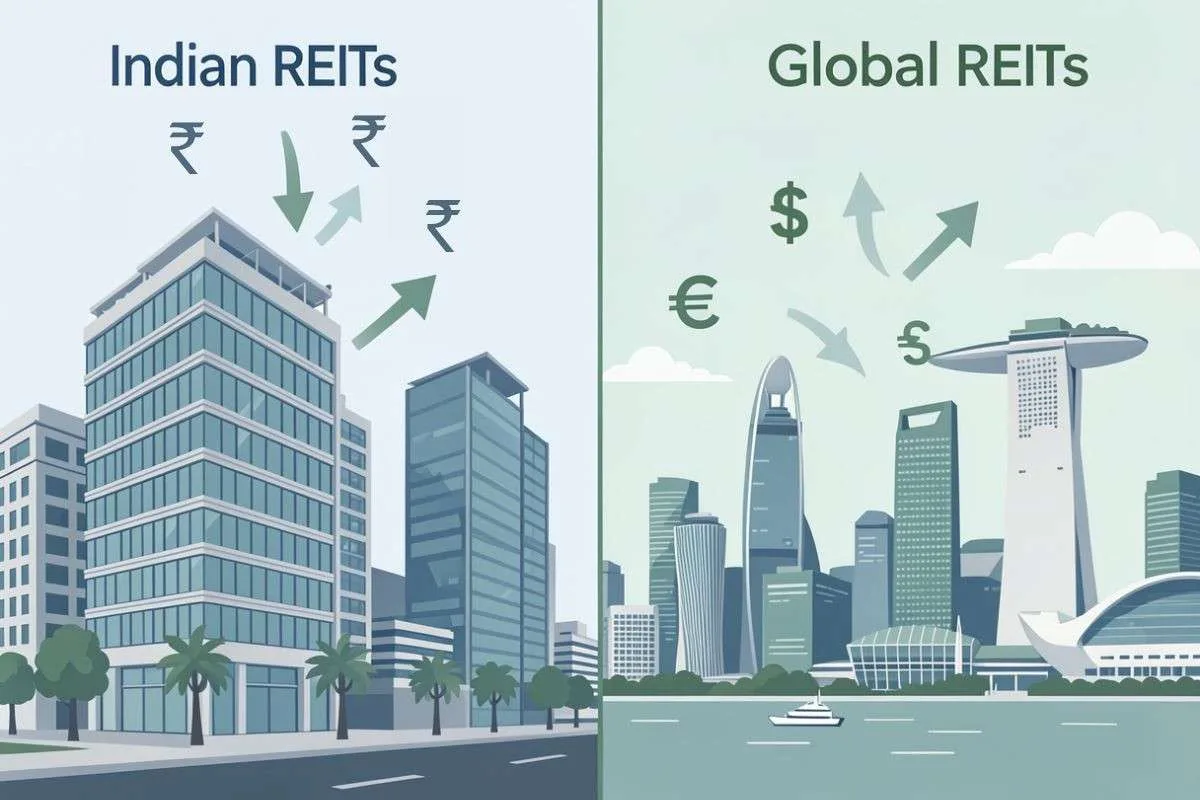
The comparison between global REITs and Indian REITs is growing among Indian investors who want to move beyond domestic real estate. Indian REITs are known for stable rental income and a familiar regulatory setup. Global REITs, on the other hand, offer access to international property markets, dollar-denominated returns, and wider geographic diversification.
The real difference, however, goes beyond yield or asset quality. Risk exposure, long-term returns, and currency impact play a much bigger role in shaping actual outcomes. Many investors underestimate how INR depreciation, foreign taxation, and exchange rate volatility can significantly change the final returns from global REIT investments.
This guide explains the true risk–return profile of global and Indian REITs, breaks down currency risk using simple INR-based examples, and helps Indian investors decide how each option fits into a well-balanced portfolio.
Risk Profile: Global REITs vs Indian REITs
Same Asset Class, Different Risk Layers
Indian and global REITs belong to the same asset class, but their risk exposure comes from very different sources. Indian REITs are mainly shaped by domestic conditions such as local economic growth, tenant stability, and regulatory policies. Global REITs, on the other hand, are affected by cross-border factors, including foreign monetary policy, global property demand, and exchange rate movements, which introduce additional layers of risk over time.
Indian REIT Risk Factors
- High concentration in office real estate
- Tenant-specific leasing and renewal risk
- Sensitivity to domestic economic slowdowns
- Changes in local regulations or tax policies
Global REIT Risk Factors
- Currency fluctuation across USD, EUR, and INR
- Exposure to global interest rate cycles
- Geopolitical and regional market risks
- Liquidity differences across international markets
| Risk Type | Indian REITs | Global REITs |
|---|---|---|
| Currency Risk | None | High |
| Regulatory Risk | Medium (SEBI) | Medium–High |
| Interest Rate Sensitivity | Moderate | High |
| Geographic Diversification | Low | High |
Key insight:
Global REITs add diversification but also introduce currency-driven volatility.
Returns Comparison: Yield vs Total Return Reality
Why Dividend Yield Alone Is Misleading
Dividend yield alone does not reflect true REIT performance, as Indian REIT returns are shaped by rental income growth, stable occupancy, and asset revaluation, while global REIT returns depend on property appreciation, dividend growth, and currency movements.
Return drivers at a glance
- Indian REITs: rental growth, occupancy levels, asset revaluation
- Global REITs: property appreciation, dividend growth, currency impact
| Metric | Indian REITs | Global REITs |
|---|---|---|
| Average Dividend Yield | 6–8% | 3–6% |
| Capital Appreciation | Moderate | Moderate–High |
| Currency Boost | No | Possible |
| Long-term CAGR | Stable | Variable |
Lower-yield global REITs can generate stronger INR returns during periods of rupee depreciation.
REITs in India: Best REIT Funds, Stocks & Returns
Currency Risk Explained for Indian Investors
Currency risk acts as a return multiplier in global REIT investments. Your final returns don’t depend only on how the REIT performs, but also on how the foreign currency moves against the Indian rupee. Returns are influenced by both real estate performance and exchange rate changes.
When the INR depreciates, global REIT returns get a boost. Even if the REIT’s price or dividend grows moderately in dollar terms, converting those returns back to INR results in higher gains. Over long periods, currency depreciation can amplify total returns for Indian investors.
When the INR strengthens, returns compress. A rising rupee reduces the INR value of foreign dividends and capital gains, even if the global REIT performs well locally. For Indian investors, currency movement can be a stronger return driver than yield alone.
Important terms for investors:
- INR depreciation
- Forex exposure
- Currency appreciation
- Exchange rate volatility
Unlike stock volatility, currency risk works silently in the background, but compounds over time.
INR Depreciation Impact: Real-World Example
What Happens to ₹10 Lakhs in a Global REIT?
Assume an Indian investor invests ₹10,00,000 in a global REIT that delivers an 8% return over 1 year.
Base Case: No Currency Movement
- Investment value after 1 year: ₹10,80,000
- Net gain: ₹80,000
- Return depends only on REIT performance
Scenario 1: INR Depreciates by 5%
- Global REIT return: 8%
- INR depreciation: +5%
- Effective return in INR terms: ~13%
- Investment value: ₹11,30,000
- Net gain: ₹1,30,000
Takeaway: Currency depreciation amplifies returns.
Scenario 2: INR Appreciates by 5%
- Global REIT return: 8%
- INR appreciation: –5%
- Effective return in INR terms: ~3%
- Investment value: ₹10,30,000
- Net gain: ₹30,000
Takeaway: Currency strength can erode otherwise solid REIT performance.
Exposure to foreign currencies allows global REITs to offset periods of INR depreciation.
How Indian Investors Should Invest in Global REITs
Choosing the right global REIT is only half the decision. For Indian investors, how you invest plays a major role in costs, taxation, compliance, and final returns. Different investment routes offer different levels of convenience, control, and complexity.
Best Routes for Indian Investors
Global REIT ETFs via Indian mutual funds
Offering international exposure without direct overseas investing. Currency conversion, taxation, and compliance are handled by the fund house, making it suitable for beginners.
International ETFs under the Liberalised Remittance Scheme (LRS)
Direct investment in global REIT ETFs offers greater control and potentially lower costs, but it also entails additional responsibilities for remittances, currency conversion, and tax compliance.
Overseas brokerage accounts
Access to a wider universe of global REITs comes with increased involvement in compliance, reporting, and portfolio tracking.
Things Indian Investors Should Watch Closely
- LRS remittance limits and annual caps
- Withholding tax on foreign dividends
- Expense ratios at ETF and platform levels
- Tax compliance and foreign asset reporting requirements
Ignoring these factors can materially reduce net returns, even if the REIT performs well.
Smart Portfolio Strategy
A balanced approach often works best:
- Indian REITs for stable income and regulatory familiarity
- Global REITs for geographic diversification and partial currency hedging
This combination helps smooth returns while reducing overdependence on a single market or currency.
Disclaimer:
This content is for educational and informational purposes only and should not be considered financial, investment, or tax advice.
FAQs
Are global REITs riskier than Indian REITs?
Global REITs carry additional risks such as currency fluctuation, global interest rate changes, and geopolitical exposure, making them riskier than Indian REITs in the short term.
How does INR depreciation affect global REIT returns?
When the INR depreciates, returns from global REITs increase in INR terms, even if the REIT’s performance remains unchanged in foreign currency.
Do Indian REITs have currency risk?
No. Total return, which includes capital appreciation and currency impact, provides a more accurate comparison than dividend yield alone.
Can global REITs act as a hedge against INR weakness?
Yes. Global REITs can partially hedge against INR depreciation because their returns are linked to foreign currencies.