
Introduction: Office Space Demand Shifts Beyond Metros
India’s commercial real estate story is no longer limited to the glass towers of Mumbai, Bengaluru, or Delhi. The focus is moving away from metros — Tier-2 cities are now leading in office demand.
Rising infrastructure investments, a booming startup ecosystem, and remote work flexibility have made cities like Indore, Coimbatore, Lucknow, and Chandigarh the new frontier for business expansion. Investors who once chased crowded metro markets are now eyeing smaller cities — where costs are lower, returns are higher, and competition is lighter.
In short, smart investors are focusing on Tier-2 cities to catch the next big growth in commercial real estate.
Learn more about this trend in our related blog: India’s Tier-2 and Tier-3 Cities Lead the Real Estate Boom
What Drives Office Space Demand in Tier-2 Cities?
The rise of Tier-2 cities isn’t luck — it’s strategy meeting timing. A combination of digital transformation, workforce mobility, and infrastructure upgrades has made these markets impossible to ignore.
Digital India and Startup Growth
India’s startup scene has outgrown metros. Tier-2 cities now host tech incubators, coworking hubs, and remote-first companies tapping into local talent. Cities like Jaipur, Kochi, and Surat are becoming startup magnets — reducing dependency on metro ecosystems.
Infrastructure Boom: Roads, Airports, IT Parks
Smart Cities Mission and AMRUT projects are reshaping cityscapes. New IT parks, logistics hubs, and upgraded airports are improving accessibility, making office leasing in smaller cities more practical and profitable.
Cost Advantage and Talent Migration
Lower rentals and operational costs (up to 40% less than metros) attract companies looking for scalability. Meanwhile, professionals are moving closer to their hometowns, creating a strong urban workforce in smaller markets.
Bottom line: Businesses are no longer expanding from metros — they’re expanding beyond them.
Tier-2 Cities With Rising CRE Demand
Far from being secondary options, India’s Tier-2 cities are emerging as commercial real estate (CRE) hotspots—and savvy investors are recognising it.
| City / Hub | Key Highlights |
|---|---|
| Coimbatore (TN) | Large deals, cost advantage, growing IT/ITeS footprint. Lease example: State Street leased 2.1 lakh sq ft (₹126 crore). |
| Indore (MP) | Strategic location, smart city investments, talent availability. Tier-2/3 CRE markets projected CAGR >20% till 2027; 42% job growth in 2025. |
| Jaipur (Rajasthan) | Infrastructure upgrades (metro, airport), rising commercial corridors. |
| Ahmedabad (Gujarat) | Established industry base, growing service economy, expanding office stock. |
| Kochi (Kerala) | Existing tech parks (Infopark/SmartCity), growing talent pool outside metros. |
| Trend / Insight | Implications |
|---|---|
| Leasing & absorption rates improving | Signals genuine demand, not just speculative construction. |
| Rental arbitrage (30–50% lower rents) | Attractive for companies; boosts leasing in Tier-2 cities. |
| Hub-and-spoke / satellite office model | Core metro operations, back-office or innovation hubs in Tier-2 cities. |
Investor Advantages: Get Urban Growth Without Metro Competition
Investing in Tier-2 office spaces is smarter. Tier-2 cities are delivering big returns like metros did, but without the high costs and overcrowding.
| Advantage | Details |
|---|---|
| Lower Entry Barriers, Higher Yield Potential | While premium metro CRE often requires ₹20–30 crore entry, Tier-2 properties start as low as ₹5–10 crore. Yields can reach 9–10% vs 6–7% in metros — boosting ROI. |
| Early-Mover Advantage | Metros are saturated; Tier-2 cities are still in the “discovery” phase. Early entrants capture land appreciation, developer incentives, and better tenant deals. |
| Government Push & Urban Master Plans | Programs like Smart Cities Mission, AMRUT, and Make in India drive infrastructure investment and attract domestic and global tenants. |
| Strong Rental Upside | Rental rates in Tier-2 markets have been growing 8–12% annually, supported by office absorption and rising corporate footprints, offering steady long-term cash flow. |
Challenges Facing Tier-2 Office Markets (and How to Solve Them)
Every growth story has speed bumps — and India’s Tier-2 commercial real estate (CRE) market is no exception. But savvy investors know that every “challenge” hides an opportunity if you know how to position yourself right.
Limited Market Data & Transparency
Compared to metros, Tier-2 cities are still gathering accurate data on rents, vacancies, and absorption.
Solution: Partner with CRE research platforms (JLL, CBRE, CREDAI-CRE Matrix) and local property consultants who track verified transactions. Build insights before deploying capital.
Liquidity and Exit Concerns
Secondary sales and large-ticket resales can take longer in smaller markets.
Solution: Focus on Grade-A properties with long-term corporate leases.
These assets retain buyer interest and maintain steady valuations — ensuring liquidity even in smaller cities.
Developer Credibility Gaps
New entrants in Tier-2 CRE markets may lack experience in large commercial builds.
Solution: Vet developers through RERA records, past delivery history, and tenant mix. Prefer projects co-developed with institutional or national players.
Infrastructure and Policy Lags
Some Tier-2 cities still face delays in last-mile connectivity and utility provisioning.
Solution: Prioritize cities with ongoing Smart City or AMRUT projects, where government investment ensures consistent infrastructure upgrades.
Awareness Gap Among Investors
Many investors still perceive Tier-2 CRE as “unproven.”
Solution: Follow leasing data, not opinions. Track how MNCs, IT firms, and coworking brands are expanding beyond metros — it’s a data-backed validation of this trend.
Key Tier-2 CRE Trends You Need to Know (2025 & Beyond)
The next five years will redefine India’s commercial real estate landscape. Tier-2 cities are not just catching up — they’re setting new benchmarks for office space demand, flexibility, and profitability.
Consistent Rental Growth & High Occupancy
According to JLL and CREDAI-CRE Matrix, Tier-2 cities recorded over 34.5 million sq. ft. of office absorption in 2024, with steady rental growth of 8–12% YoY.
Source: Hindustan Times
As more corporates and shared-office operators move in, occupancy rates now rival smaller metro submarkets.
The Rise of Flexible & Hybrid Workspaces
Flexible space demand in non-metro cities grew 40% YoY in 2025, driven by remote and distributed work models.
Brands like Awfis, Smartworks, and 91Springboard are expanding aggressively into cities such as Jaipur, Indore, and Coimbatore to capture this untapped audience.
Expansion of Satellite & Hub-and-Spoke Offices
Large enterprises are adopting the hub-and-spoke model — keeping HQs in metros while setting up satellite offices in Tier-2 cities for cost optimization and workforce retention.
This trend is particularly visible in IT/ITeS, BFSI, and logistics sectors.
Government Incentives Boosting Commercial Demand
Urban renewal programs under Smart Cities Mission and PM Gati Shakti are leading to massive infrastructure spending — highways, metro extensions, and airport connectivity — all of which directly increase office space absorption potential.
Investor Shift Toward Diversified Portfolios
High-net-worth investors and funds are now including Tier-2 CRE assets for portfolio diversification. Fractional ownership platforms are accelerating the trend, allowing smaller investors to tap into institutional-grade properties.
Actionable Takeaways for CRE Investors in Tier-2 Cities
If you’re serious about entering India’s next growth wave in commercial real estate, here’s your playbook.
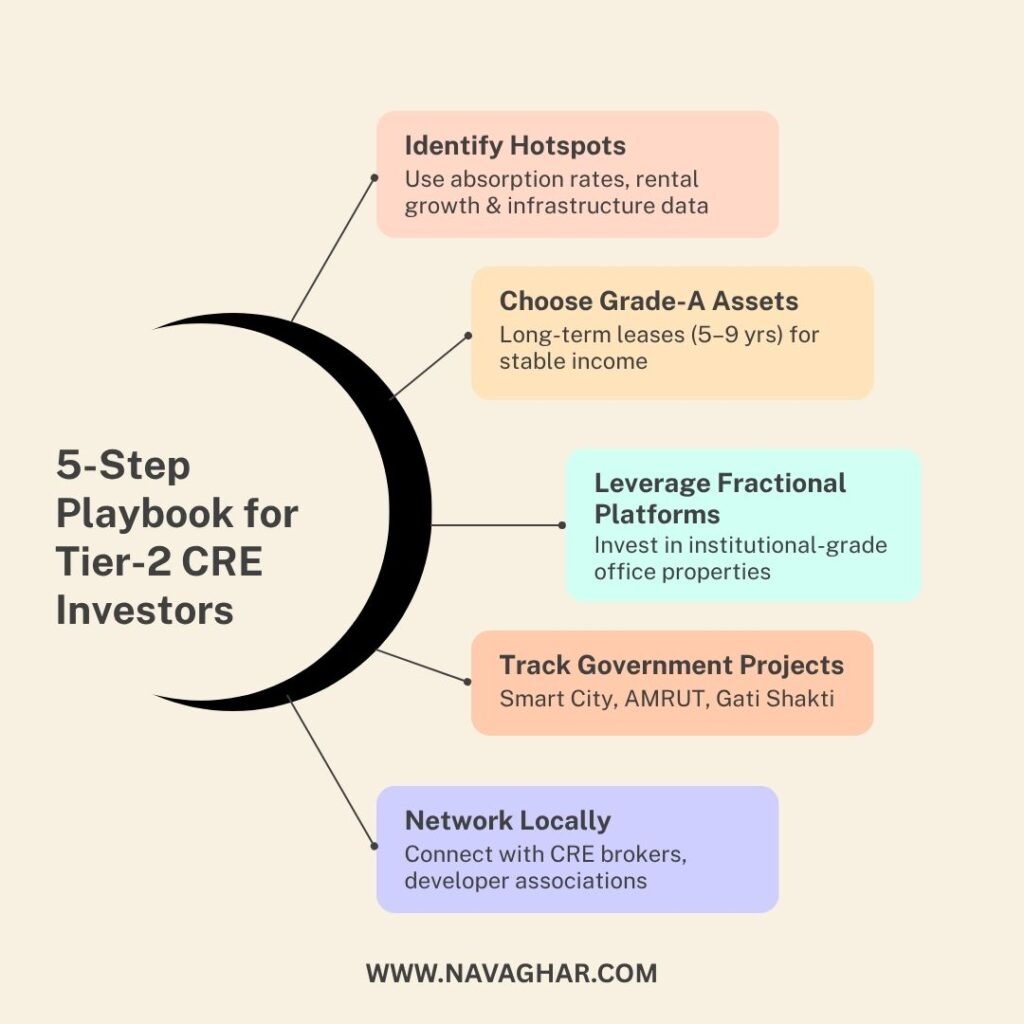
These steps help you move from interest to execution — with minimal risk and maximum upside.
Step 1: Identify Hotspots
- Use absorption rates, rental growth & infrastructure data
- Focus: Indore, Coimbatore, Jaipur, Lucknow, Kochi
Step 2: Choose Grade-A Assets
- Long-term leases (5–9 yrs) for stable income
- Verified corporate or flexible workspace tenants
Step 3: Leverage Fractional Platforms
- Invest in institutional-grade office properties
- Entry as low as ₹10 lakh (PropShare, RealX, Strata)
Step 4: Track Government Projects
- Smart City, AMRUT, Gati Shakti
- Infrastructure boosts long-term property value
Step 5: Network Locally
- Connect with CRE brokers, developer associations
- Identify credible developers & emerging corridors early
Conclusion: Why Ignoring Tier-2 Office Demand Risks Missing India's Next CRE Wave
India’s commercial real estate growth story is being rewritten — not in glass towers of metros, but in the fast-rising skylines of Tier-2 cities.
Today, Tier-2 cities give investors what metros offered 15 years ago — lower costs, growth potential, and access to skilled talent, with modern infrastructure and a digital-first economy.
The difference? The opportunity window is smaller this time. Institutional investors and large developers are already mapping entry strategies across emerging hubs like Indore, Coimbatore, and Surat.
Tier-2 commercial real estate is a smart strategy, not a risk. Early investors can profit from rising property values and join India’s next urban growth story.